Physical Address
304 North Cardinal St.
Dorchester Center, MA 02124
Physical Address
304 North Cardinal St.
Dorchester Center, MA 02124
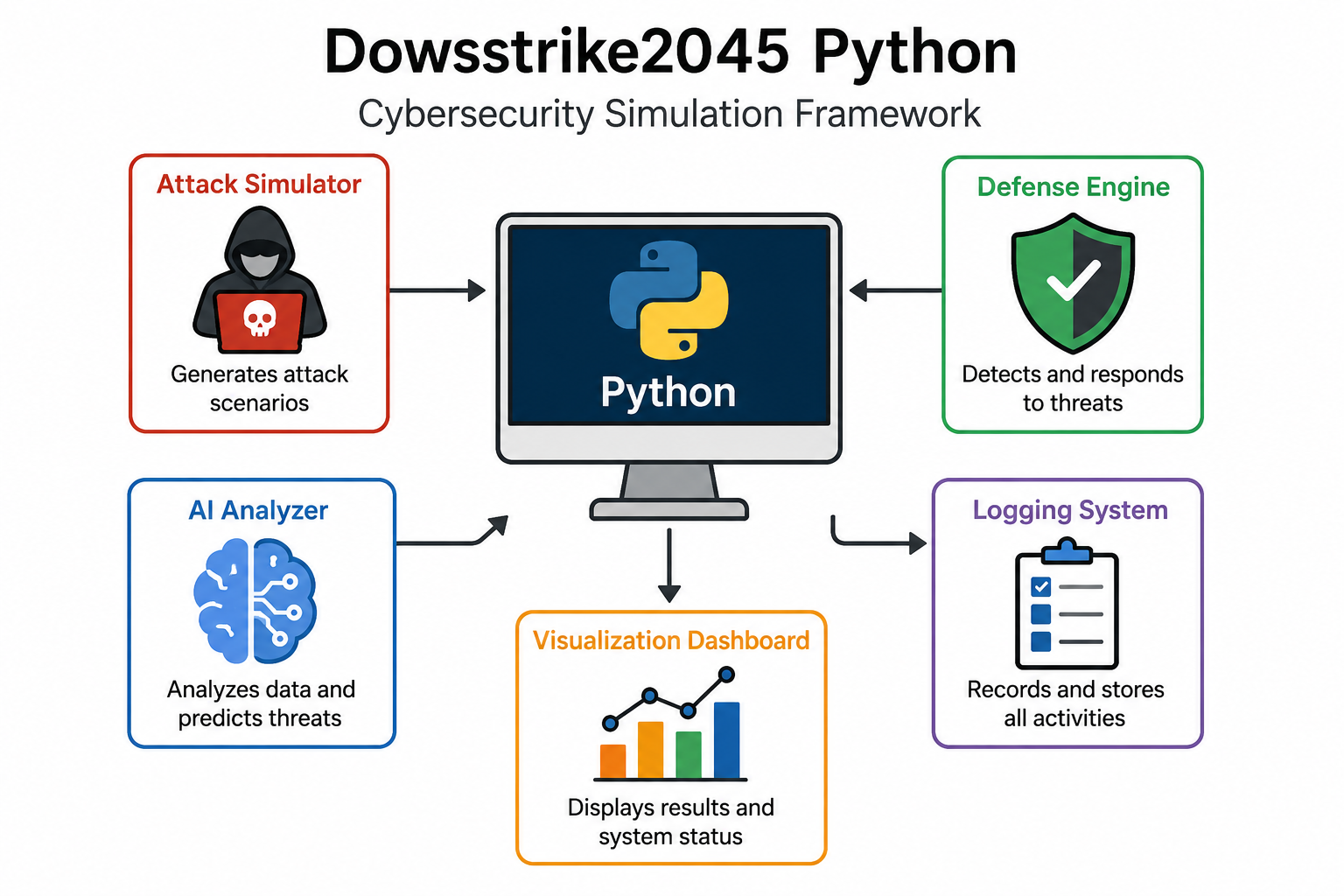
In recent years, the demand for advanced cybersecurity simulation tools has increased rapidly. One of the emerging conceptual frameworks often discussed in development and security communities is “dowsstrike2045 python”. While the term itself is not tied to a single official software product, it is widely used to describe a Python-based cyber simulation and defensive stress-testing environment designed to model large-scale digital attack-defense scenarios.
In simple terms, Dowsstrike2045 Python can be understood as a fictional or prototype framework that helps developers simulate cyber events, test system resilience, and study defensive strategies using Python programming.
This article explores its architecture, modules, use cases, features, and how such a system could be designed using Python in a safe, ethical, and educational way.
Dowsstrike2045 Python can be described as a conceptual cybersecurity simulation framework built in Python. It is not a real-world commercial product but rather a structured idea often used in discussions about:
The “2045” in the name is symbolic, representing future-oriented cybersecurity systems that combine automation, AI, and predictive defense mechanisms.
Instead of performing real attacks, this framework focuses on:
The main goals of such a system include:
A typical Dowsstrike2045 Python framework would be divided into multiple layers.
| Layer | Module Name | Function |
|---|---|---|
| 1 | Simulation Core | Controls virtual environment behavior |
| 2 | Attack Simulator | Generates controlled test scenarios |
| 3 | Defense Engine | Detects and responds to threats |
| 4 | AI Analyzer | Uses machine learning for prediction |
| 5 | Logging System | Records all activities |
| 6 | Visualization Layer | Displays graphs and dashboards |
Each layer works together to simulate realistic cyber environments without harming real systems.
A well-designed Python-based framework like this would include several advanced features:
This module creates virtual cyber events such as:
Machine learning models can be trained to:
A visual interface shows:
All simulations run in isolated environments to ensure safety.
Python scripts control:
Python is the ideal language for such a system because of its:
| Library | Purpose |
|---|---|
| NumPy | Data processing |
| Pandas | Log analysis |
| Scikit-learn | Machine learning models |
| Matplotlib | Data visualization |
| Socket | Network simulation |
| Asyncio | Concurrent events |
Here is how a typical simulation flow works:
This entire process happens in a safe, isolated Python environment.
Below is a simplified conceptual example (not a real attack tool, just simulation logic):
import random
import time

class SimulationEngine:
    def __init__(self):
        self.status = "Running"

    def generate_event(self):
        events = ["LOGIN_ATTEMPT", "TRAFFIC_SPIKE", "PING_REQUEST", "SYSTEM_CHECK"]
        return random.choice(events)

    def run_simulation(self):
        for i in range(10):
            event = self.generate_event()
            print(f"Event Generated: {event}")
            time.sleep(1)

sim = SimulationEngine()
sim.run_simulation()
This example demonstrates event simulation logic, not real-world network interaction.
Such a framework (in concept form) can be used in many fields:
Students can learn:
Researchers can train models to:
Companies can simulate:
Universities can use it for:
Even though the concept is powerful, there are limitations:
Large simulations require strong hardware.
AI predictions depend heavily on training data.
Such systems must never be used for real-world harmful activities.
As simulations grow, system management becomes harder.
It is extremely important to understand that any system like Dowsstrike2045 Python must be:
Cybersecurity simulation tools should always follow responsible computing practices.
By 2045 and beyond, we can expect:
The future will likely merge AI + cybersecurity + automation into unified systems.
| Feature | Traditional Security Tools | Dowsstrike2045 Python Concept |
|---|---|---|
| Automation | Limited | Highly automated |
| AI Integration | Partial | Deep integration |
| Simulation Ability | Basic | Advanced virtual environments |
| Learning Capability | Static | Adaptive and evolving |
| Visualization | Minimal | Real-time dashboards |
A typical Python project for such a system might look like:
dowsstrike2045/
│
├── core/
│   ├── engine.py
│   ├── simulator.py
│
├── ai/
│   ├── model.py
│   ├── trainer.py
│
├── defense/
│   ├── firewall_sim.py
│   ├── detector.py
│
├── logs/
│
└── dashboard/
    ├── app.py
This structure helps organize simulation, AI, and defense components separately.
Even though “dowsstrike2045 python” is not a real product, it represents an important direction in technology:
It is a vision of how cybersecurity tools might evolve in the future.
Dowsstrike2045 Python can be understood as a future-oriented conceptual framework that demonstrates how Python can be used to build advanced cybersecurity simulation environments. It focuses on controlled testing, AI-driven analysis, and defensive strategy modeling rather than real-world attack systems.
As technology advances, such frameworks will become increasingly important in helping organizations prepare for complex digital threats. Python will continue to play a central role due to its flexibility, simplicity, and powerful ecosystem.
No, it is a conceptual framework used for educational and discussion purposes.
No. It is strictly intended for simulation and cybersecurity research only.
Because Python supports AI, automation, and data analysis very efficiently.
To simulate cyber environments and improve defensive strategies.
Yes, it is actually useful for learning cybersecurity and Python programming.

